
raison d'etre
march 2020
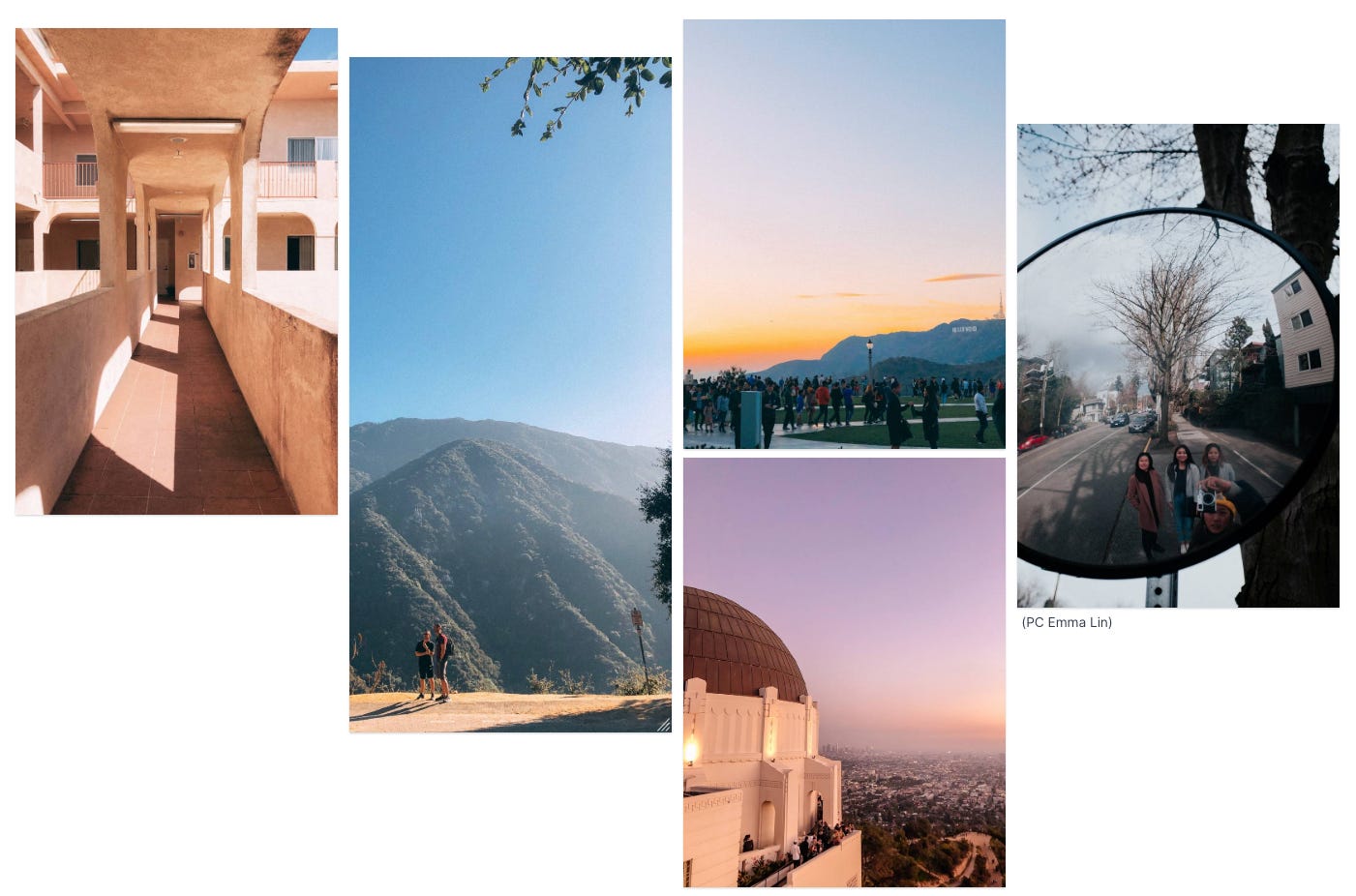
Left to right: Culver City / Angeles Mountains / Griffith Observatory / Ballard (Seattle)
My friends —
Happy March!
March always seems to creep up out of nowhere. I know, for some reason, whenever February is around the corner. January, of course, is announced with such fanfare. March, though...
One of my friends is convinced that March is the douchebag of months. You think it is almost spring and warm weather will abound. It comforts you with sunny 80 degree days and you get all excited to break out the sundress and then. It turns around and ghosts you with week-long 40 degree downpours.
I had a run with the stomach flu last week. Reminded me how to deal with pain. It hurts like hell, as pain does, but then you come to terms that no amount of resisting will change a thing. So you sit and grimace and bear it and then it is over. Nothing too scary.
I must admit this is partly the post-sickness glow speaking. I have been shamelessly frolicking in that sweet little spell where simply living itself feels so lucid! and alive! Every step fills you with a giddy appreciation of how lucky you are to be able-bodied and to be able-to-go-outside? In the sunshine? And not be hunched over a toilet for dear life? Incredible.
But in all seriousness, considering all this fear and uncertainty going around about COVID-19, it was a much-needed nudge to be grateful.
MI
Monthly Inputs: some of my favorite recent reads
Website: Sideways Dictionary by Jigsaw
A fun concept.
Long-form Article: Greater Los Angeles by Geoff Manaugh (~1000 words)
Los Angeles is where you confront the objective fact that you mean nothing; the desert, the ocean, the tectonic plates, the clear skies, the sun itself, the Hollywood Walk of Fame – even the parking lots: everything there somehow precedes you, even new construction sites, and it’s bigger than you and more abstract than you and indifferent to you. You don’t matter. You’re free.
Manaugh writes about this deep, complicated love I have always felt but have never been able to articulate for LA. And he does so masterfully in the most glorious rant I have read in recent memory.
Non-Fiction Book: Bird by Bird: Some Instructions on Writing and Life by Anne Lamott (272 pages)
All the good stories out there are waiting to be told in a fresh, wild way. Mark Twain said that Adam was the only man who, when he said a good thing, knew that nobody had said it before. Life is like a recycling center, where all the concerns and dramas of humankind get recycled back and forth across the universe.
Lamott is just. Phenomenal. She’s the kind of author that reminds you of life’s truths in a way that is refreshingly witty and sweetly nostalgic. I read this book to learn how to write better. I walked away with so much more.
Fiction Book: The Wind-Up Bird Chronicle by Haruki Murakami (607 pages)
Sometimes, when one is moving silently through such an utterly desolate landscape, an overwhelming hallucination can make one feel that oneself, as an individual human being, is slowly coming unraveled. The surrounding space is so vast that it becomes increasingly difficult to keep a balanced grip on one’s own being. I wonder if I am making myself clear. The mind swells out to fill the entire landscape, becoming so diffuse in the process that one loses the ability to keep it fastened to the physical self. That is what I experienced in the midst of the Mongolian steppe.
I’ve been trying to read more fiction lately, and people have recommended Murakami more times than I can count. I don’t know how much of this can be proven, but if anything, it has brought me a lot of joy (and what more can you ask for)?
I’m not even at the halfway mark yet but I’m already having a spectacular time watching him set up the universe. Murakami’s diction is so simple and uncluttered yet thoroughly hypnotic. Reading Murakami is like dreaming in anime. Those animators make commuting or eating or walking down the street in the literal pouring rain feel like a slice of heaven. They turn the mundane mystical.
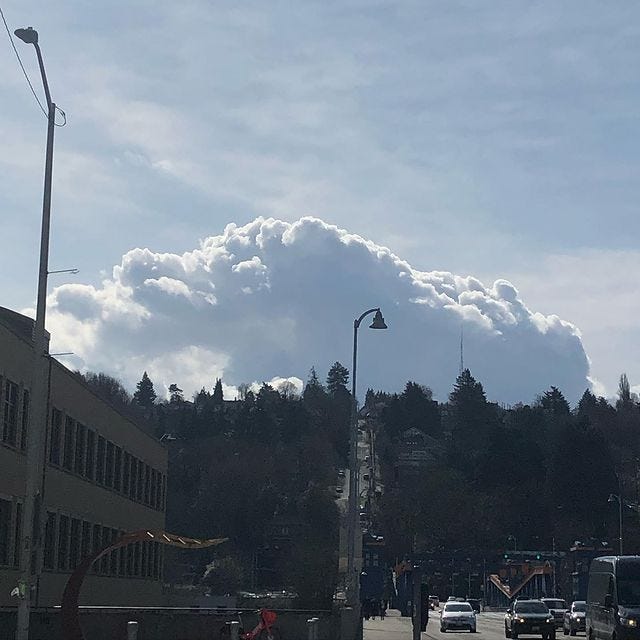
But most importantly— cloud of the month:
raison d’etre
It’s strange, seeing someone you haven’t since you were sixteen.
Both of you now completely different people, yet in so many ways the same.
He had sat behind me in Calculus eight years ago. Would tease me, occasionally, the way high school boys will do to high school girls— kick the metal basket under my desk chair, snicker when I’d whirl around.
We still followed each other on Instagram. Every so often we’d comment on each other’s Stories. One day we realized that we both lived in LA.
Wanna get dinner on Thursday?
Done.
One of those exchanges that make you go — wow, for all the hate social media gets, it can really get shit done sometimes. Create a connection where there would have been none.
So here I was, following him in circles, up the staircase to his apartment. It occurred to me that I knew this person no more than I did any stranger walking down the street. Didn’t know where he went to college, what he did for a living, how he viewed the world.
Nothing.
But we’d shared a year of lectures — hour after hour in that same classroom corner, watching the post-lunch sun dust drift idly through the door, settle soft on the linoleum as Mrs. P’s voice droned on and on and our eyelids made war with gravity.
And that ought to mean something, right?
We reached the top. He pulled open a steel door and waved me into an airy industrial warehouse, one that stretched so far I found myself squinting a little to see the other side. On one end he gestured at the loft he’d constructed, a wooden enclave hoisted high like an urban treehouse. On the other end, a huge curved wall gerrymandered the space, seemed to serve little to no purpose at all.
An architect used to live here, he explained.
Of course.
Our footsteps echoed as we walked past 3-D printers whirring, half-finished projects strewn across the floor, a race car he’d built from scratch in college. He showed me the kitchen. Oh yeah, we don’t get gas in here, he laughed. A 40kg propane tank sat underneath the table, powering the stove.
He began crawling through a narrow window onto the outside ‘patio’ — really, just a short metal ledge jutting out from the tin wall — and beckoned for me to follow. I crouched through, stepped gingerly into the darkening sky.
We stood there for a bit, perched among towering smokestacks, lofted over a sea of aluminum rooftops.
You’re looking at the largest artist colony in the world, he told me. The Brewery Artist Lofts.
In the distance, Downtown flickered on, glittering.
What kind of art do you do? I asked.
Well actually, I’m not technically an artist, he grinned. I kinda finessed my way in here.
But he’d studied engineering in college, he told me. Fell in love with it — was why he’d built all these things — his loft, his race car, and now, a team, to launch his start-up. Social engineering, he smiled, evidently pleased with the congruity of this term. But he was also dabbling in restaurant design with his cousin, working on an auto mechanics project with his roommate, and oh, I freelance on the side sometimes too, he added.
I marveled. At this lifestyle he spoke of, this community he lived in. That he could build and create and do right next to other builders and creators and doers. How we’d grown up in the same academic pressure cooker suburb and now lived in this sprawling concrete hodgepodge and yet — how completely and utterly different our worlds were today.
My building tag dug into my waist, pinching my skin painfully. I sighed. Shifted it as I’d done many times before. I was a mere 15 minutes from my office, but the work I’d done that day felt heavy and alien. Dimensions away.
A light breeze tugged me back to the evening before me.
The largest artist colony in the world, I mused.
Some part of me flickered a little. Yearned.
—
We drove to Silver Lake — one of LA’s more distinctive locales— for dinner. Two parts San Franciscan earthy, one part Venice Beach bohemian, sprinkled with a trendy mid-century flair.
I was so occupied with keeping track of all these projects and products and apps that he continued to rattle off that I barely noticed we’d arrived.
We were at some type of arcade-restaurant.
A neon orange luminescence drenched it all— bounced off menus, softened table corners, soaked deep, deep down into the colorful retro carpeting. I felt curiously warm towards the other patrons. All of us together in this soft glowing establishment, tucked away from the sharp edges and harsh white fluorescences of the work week.
We made our way to a corner booth and sat beside a row of arcade machines that greeted us with pings and pews.
Okay. So what do you do? he asked.
I’m a human capital consultant, I told him, not sure what I really meant. But I did know I disliked the politics of working for a large corporation. Dreaded the Sisiphyean hours spent on tedium that clients might never use. Exasperated by the inefficiency of commuting two hours every day to be productive for maybe four. And all of it, typically, shallow and reactive work! Rarely deep work. And don’t get me started on the ridiculous cycle of spending money on things I don’t need to keep myself sane enough to go earn more money...how demoralizing the whole charade was!
I took a breath.
I mean -- it’s not nearly as bad as I make it sound, I laughed.
But just because things could be worse doesn’t mean I can’t want it to be better, right?
He nodded knowingly.
Are you guys ready to order?
A server had come by. Smiled expectantly.
Sorry, could we get a few more minutes?
I turned back to face him.
Like — I would love to do what you’re doing.
He smiled. His eyes followed the server as he walked back to the kitchen. Then back at me. He remained silent for a few beats.
Then he told me that this was going to be the first meal he had eaten all day. That after this, he was going to go home, probably work until three in the morning, then wake up at seven to do it all over again. On Fridays and Saturdays too. How he was still the sole investor in his company and how it wouldn’t be unlikely for him to come out on the other side of this idea in a couple years and find that — the market doesn’t care how much work you’ve put in, the market only cares if you add value. And he’d look around at his peers in their tech and finance management roles with their 401ks and their rungs of success, getting married and having kids and buying houses and find himself alone, with none of the above.
The server came by again.
Sorry, sorry, just a few more minutes, please.
I reached for my water glass and found it empty, ice cubes clinking at the bottom. I lifted it up to my lips anyway.
He was right.
Life doesn’t work that way, does it? You don’t just leave one thing and go to another thing and find that all your problems suddenly disappear.
Oh, but it was so nice to have this little fantasy — an easy and painless existence— tucked away in my back pocket, to jet off to and daydream about whenever the corporate doldrums got a little too doldrumy.
A loud clang! from the arcade machines brought me back to the conversation.
But are you happy? I asked.
Of course, he replied.
It’s just a matter of values and pain, right?
For you, it seems like you value the stability and security of knowing that rent will be taken care of and that you will be (somewhat) prepared for life’s emergencies when they come. That you have the opportunity to work with smart people and learn from smart people and grow in areas you might not push yourself to otherwise. That you can have a personal life — shut down your laptop when you’re done and really be done.
I’d guess that, for now, these things balance out the pain of doing things you may not find particularly impactful. The unpleasant things that come with working for a really big — working for any really big— client-facing company. Pushing forward someone else’s dream.
For me, it’s just a different type of pain. Carrying the weight of the risk day in and day out. Having to prove myself and my work to everyone I meet. Feeling the pressure of meeting — of exceeding — the expectations of people on my team, my partners, my family. Losing half my friends before I realized I needed to learn how to balance in life.
But none of this outweighs the upside. The flexibility I have of choosing what I want to do with my time, to identify what matters to me every single minute of the day, every day of the week. The freedom to work on my dream.
A flash of orange illuminated his face, and I saw, for the first time, not the projects or the warehouse, the freelancer or the entrepreneur, but the kid, the one that sat behind me in Calc.
And sitting in front of him, I saw sixteen year old me. Still half-asleep in that stuffy little corner of afternoon lecture hour. Working hard to get good grades! but also playing soccer and practicing piano so she could appear well-rounded! so she could get into a good college so she could get a respectable corporate job...so she could be where I was now.
She looked up from her textbook. Stared straight at me.
So are you happy?
Is it the right pain?
—
If you’ve gotten this far,
thank you.
Will every monthly release be like this?
I don’t know.
If you’d like to come along and find out,
Here are some more details,
And if you want,
and with that,
MELO OUT